

Four Priorities, One Story – An Overview of the Synod and Presbytery Joint Strategic Priorities
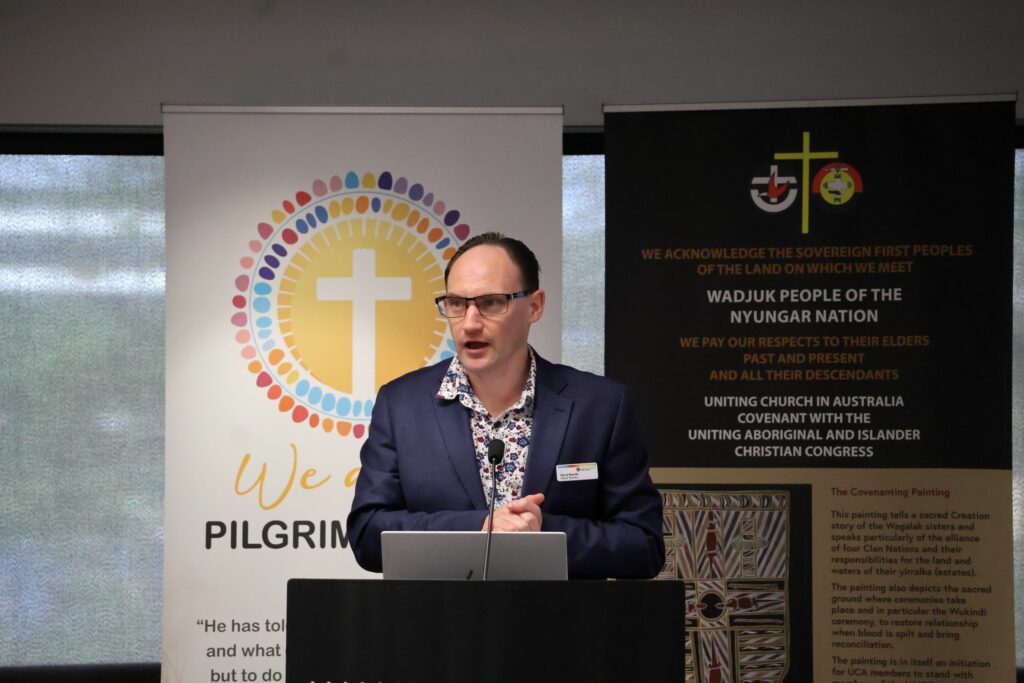
Uniting Church WA General Secretary David Beards recently outlined the current strategic priorities of the Synod and Presbytery of Western Australia at the 50th Annual Meeting of the Synod of WA.
Four Strategic Priorities
Our Strategic Priorities are not simply a list of projects, nor are they another layer of administration. They are about focusing our limited resources, aligning the work of the Synod and Presbytery, and helping us move together towards a shared future.
The four priorities are:
- Strengthening Congregations
- Strategic properties
- Increasing financial stability and sustainability
- Strengthening the Covenant
These priorities were developed following the Strategic Framework approved at the 2022 Synod and subsequent discussions in 2024. Their purpose is to help us work towards the same goals.
Although we describe them as four separate priorities, they are deeply connected. We cannot strengthen congregations without leaders, suitable property and sustainable resources. Property decisions must be shaped by mission, not simply by financial return. Financial stability must enable the mission of the Church, rather than become an end in itself. And our Covenant with First Peoples must influence the way we listen, make decisions, share resources and undertake mission together.
Strategic Priority 1: Strengthening Congregations
Strengthening Congregations includes identifying and resourcing congregations and faith communities with potential for effective ministry and mission, planning for new and renewed forms of ministry, developing leaders, promoting intergenerational and intercultural communities, and ensuring property supports mission.
The work includes the Health and Vitality Toolkit, listening to congregations, examining emerging forms of ministry, and developing a strategy for ministry. It also recognises that volunteers remain at the heart of our congregations and faith communities and that we must value, encourage, support, and sustain them.
This is the starting point for the other priorities. Before deciding which properties are strategic, we need to understand where ministry is growing, where new missional opportunities may emerge, what kind of facilities are needed, and where an ongoing Uniting Church presence is important.
Rev Claire Pickering, Presbytery Minister (Strategic Priorities) recently wrote a reflection on the insights from the Strengthening Congregations area of work which you can read here.
Strategic Priority 2: Strategic Property
The second priority is identifying and prioritising strategic properties.
Our property portfolio of 170 properties is a considerable gift, but property is not the mission of the Church. Property exists to serve mission.
This priority asks us to look across our properties and identify those with strategic missional importance, income-generating potential, or both. It calls us to consider location, function, congregational vitality, community need, financial sustainability and the future shape of ministry.
In practical terms, we are asking several important questions:
- Is this property in a location where we believe the Church should maintain a long-term missional presence?
- Does the building meet the present and future needs of the congregation?
- Could the site support new ministry, affordable housing, community services or a partnership with one of our agencies?
- Could part of the property produce sustainable income while the remainder continues to support worship and mission?
- Would the congregation’s mission be strengthened by using alternative premises, rather than continuing to carry the cost and administrative burden of a property that is no longer fit for purpose?
These are not easy questions. Church buildings hold memories, stories and deep emotional significance. Therefore, property conversations must be pastoral, transparent and grounded in mission. They require listening, consultation, professional advice and careful discernment.
There are some examples of this with property feasibility work for Armadale Uniting Church; at Spearwood Uniting Church adding an accessible toilet to enhance their outreach mission; working with our Indonesian congregation, GKI Perth, who are bursting at the seams, to find fit for purpose premises; working with Rockingham Uniting Church on a feasibility study to expand their premises for both worship and outreach services, to name just a few examples.
We also need to manage expectations. Property development is complex and often slow.
Property can enable mission, but sustainable mission depends on people, vision, leadership, and the support structures that surround them. Property development is not an end in itself. Its purpose is to create opportunities for mission, helping congregations flourish through greater ministry capacity, stronger community connection, improved financial sustainability, and enhanced ability to respond to local needs.
The current work includes reviewing properties against missional and functional requirements, identifying an initial list of sites with income potential, speaking with responsible bodies, investigating partnerships for affordable housing, and developing an overall property strategy.
This priority connects directly back to Priority 1. We cannot make wise property decisions unless we understand the future of congregations and ministry. It also connects directly to Priority 3, because appropriately used property can reduce costs, release resources and generate sustainable income.
Strategic Priority 3: Increasing Financial Stability and Sustainability
It is important to distinguish stability from sustainability. Financial stability is our ability to meet our obligations from year to year, including during unexpected shocks, without disruptive cuts. Financial sustainability is our ability to maintain mission and operations over the longer term through resilient income streams and an operating model that reflects our actual staff and volunteer capacity.
There is a linkage with the Assembly’s Act2 project, and we are working with the Commission for Governance Resourcing, and Administration.
With Stipends increasing, ongoing maintenance costs for manses, and congregations without a manse and renting a house for a minister, it is challenging.
This is not about accumulating money for its own sake. Money, property, time and people are resources entrusted to the Church for mission.
We are called both to step out in faith and to be careful stewards. Prudent financial management is not in competition with mission. It helps protect the Church’s witness, supports ministry and ensures future generations are not left with avoidable risks.
The financial challenge is shared, although it appears differently across the Church.
The Synod relies on investment income, management fees, endowments, grants, insurance-related income and property income. The Presbytery relies significantly on Mission and Service contributions, Synod support, endowments, and grants. Congregations depend on offerings, donations, property use, fundraising, grants, bequests and investment income. Each of these sources carries opportunities and risks.
Priority 3 therefore requires us to explore both new income and better use of existing resources.
This may include making better use of church buildings, developing long-term leases, partnering with agencies and charities, considering mixed-use developments, encouraging appropriate bequests, reviewing fees and services, and carefully investing proceeds or reserves. For congregations, even relatively modest improvements to facilities, promotion and hire arrangements may create more consistent income and stronger community connections.
We must also work smarter. Every new initiative has an administrative footprint. A proposal that generates income but creates an unreasonable burden for staff or volunteers may not achieve a genuine net benefit. Each idea must be assessed for its impact, timeframe, risk, dependencies, next steps and who will lead it.
Financial stability also means recognising the risks before us. Redress and civil litigation may place further pressure on our resources. Major capital withdrawals can reduce future investment earnings. Ageing buildings, compliance obligations and construction costs affect congregations as well as the Synod.
Priority 3 is therefore not merely the responsibility of the Finance team. It requires close work between all parts of the church.
Strategic Priority 4: Strengthening the Covenant
This priority reminds us that our future must be discerned with Uniting Aboriginal and Islander Christian Congress (Congress) and First Peoples, not simply on their behalf. Covenant must be reflected in our relationships, decision-making, property discussions, allocation of resources and shared ministry.
Its work includes encouraging congregational engagement, addressing Congress property matters, supporting Congress ministry and exploring how worshipping communities may be strengthened.
This priority is not separate from the other three. Strengthening congregations includes Congress communities. Strategic property includes property used for Congress ministry, evidenced by the manse purchase and refurbishment, and the continuing discussions for Tammin. Financial stability includes the fair and sustainable resourcing of Congress. Covenant must be woven through everything we do.
Four Priorities, One Story
Our four priorities ultimately tell one story.
We want healthy and flourishing congregations, equipped for ministry and mission. We want property that serves mission rather than becoming a burden to it. We want sustainable finances that allow us to act faithfully today while preparing responsibly for tomorrow. And we want to walk more deeply in Covenant with Congress, listening, learning and making decisions together.
The Strategic Priorities have already brought people together from across the Synod, Presbytery, Congress and congregations. They are strengthening collaboration, shared ownership and mutual support.
We are realistic about the challenges we face, but we are not without hope. God has entrusted us with people, relationships, property, finances, experience and imagination. Our task is to steward these gifts courageously and faithfully.
The future will not be secured by any one committee, congregation, staff team or council. It will be shaped by all of us, listening to one another, working together and remaining attentive to where God’s Spirit is already at work.
Reflection by David Beards, General Secretary, Uniting Church WA
Photos by Wendy Hendry